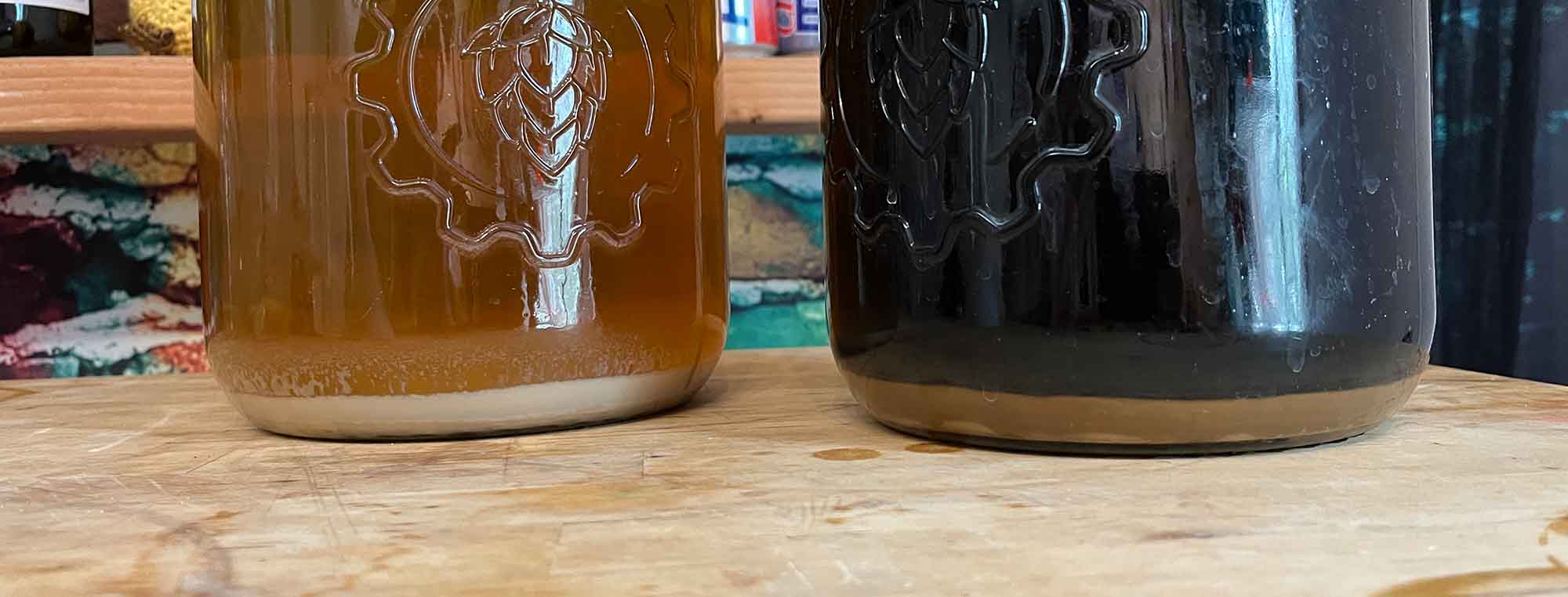
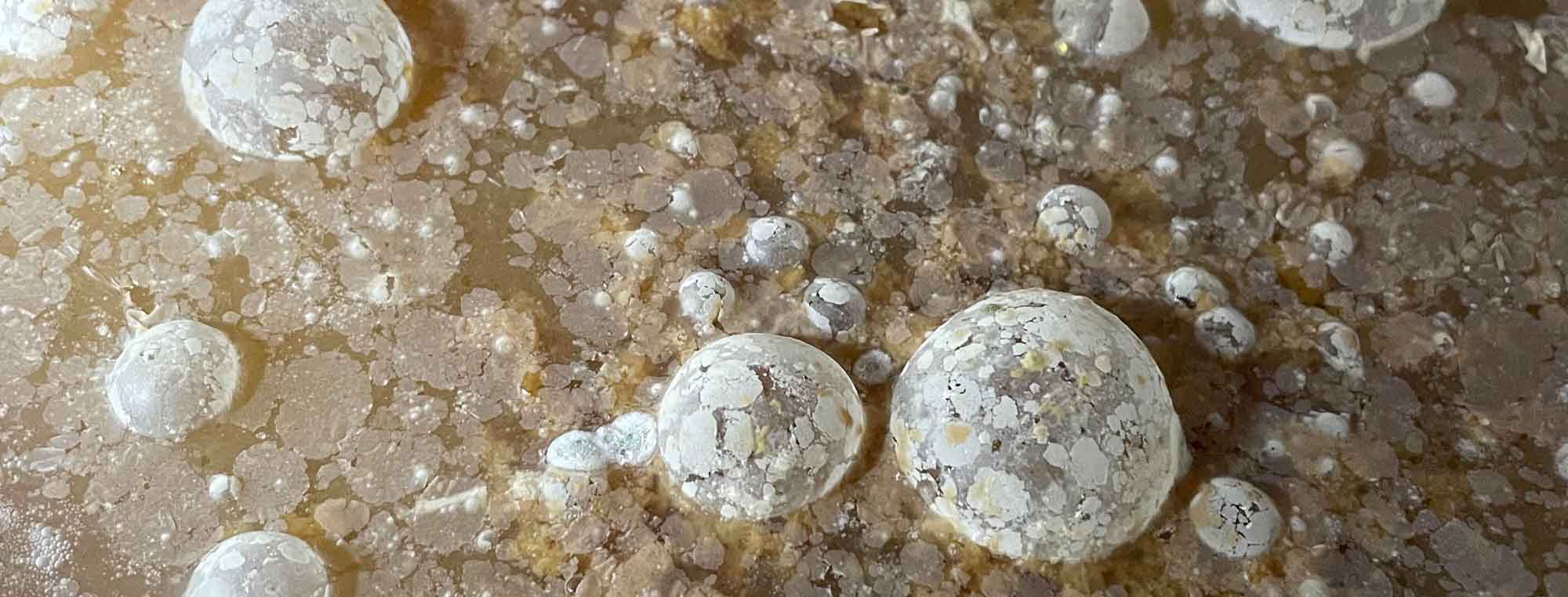
You open your fermenter and see a thin white film on the surface.
Someone tells you, “Oh that’s just kahm yeast.” Maybe it is.
But that answer is not as scientific as it sounds.
Kahm yeast is not one species of yeast. It is not a defined contamination. It is not something you can identify with certainty from a photograph.
“Kahm” is a traditional fermentation term used for a surface film or scum produced by microorganisms. In modern home fermentation, the term is usually used for film-forming wild yeasts, especially yeasts that grow well where the liquid meets oxygen. That distinction matters.
A surface film can be made by different yeasts. Some bacteria can make surface films. Some intentional fermentations produce pellicles. Some spoiled beverages develop films that should not be treated as harmless “kahm.”
So instead of asking: “Is this kahm yeast?”
A better question is: “What is growing on the surface, and what does that tell me about my fermentation?”
What Does “Kahm Yeast” Actually Mean?
“Kahm yeast” is a common name, not a species name. It describes nothing particular.
The organisms traditionally associated with the term are film-forming, usually oxidative yeasts. Genera such as Pichia, Candida, Debaryomyces, and related yeasts can form films on the surface of fermented liquids. Wine microbiology also documents surface films made by several other yeasts.
These organisms have something important in common: They can grow at the air-liquid interface.
The surface of a fermenter has much more oxygen than the liquid below it. This creates a different environment from the main fermentation. Some film-forming yeasts are particularly good at using that environment. They can form a thin layer of cells and extracellular material across the surface. This is often called a pellicle or film. That is where the terminology starts to get messy.
Kahm Is Not a Species
You will sometimes see articles say:
“Kahm yeast is Pichia.”
That is too simple.
You may also see:
“Kahm yeast is Candida.”
Also too simple.
You may see a list of several species and be told that those are “the kahm yeasts.” That is closer, but it still gives the term more precision than it actually has. Different film-forming yeasts can produce similar-looking growth. The same species can behave differently under different conditions. Other microorganisms can also produce surface films. Researchers identify these organisms by methods such as microscopy, culturing, and genetic testing.
You cannot reliably identify the species by looking at a white film through a carboy.
This is why “kahm” is best treated as a descriptive term. It tells you what the growth looks like and what type of microbial behavior it resembles. It does not tell you exactly what organism is present.
So What Is a Pellicle?
A pellicle is a physical structure. It is a film or surface layer produced by microorganisms growing at an interface. The word does not mean “bad.” The word certainly does not mean “kahm.” And the word does not even necessarily mean yeast.
Yeasts can make pellicles. Bacteria can make pellicles. Mixed microbial communities can make them.
This is an important distinction:
| Term | What it tells you |
| Kahm yeast | Informal name for certain surface-film growths, usually associated with wild yeasts |
| Film yeast | A microorganism capable of growing as a surface film |
| Pellicle | A physical microbial film or surface structure |
| Mold | Filamentous fungi that produce visible hyphae and spores |
| Infection/contamination | Microorganisms growing where you did not intend them to grow |
“Kahm” describes a type of microbial growth. It does not provide a laboratory identification. Generally when someone says “kahm,” they mean “pellicle.”
Why Does Kahm-Like Growth Form?
Oxygen is one of the biggest clues. A sealed, actively fermenting beverage is a difficult environment for many surface organisms. A fermenter with a large headspace, a loose lid, a poorly fitted bung, or repeated opening gives oxygen-loving microorganisms an opportunity.
This is why surface films often appear when fermentation slows down. Early in fermentation, your brewing yeast may dominate the environment.
- There is also plenty of CO₂ production.
- The liquid is moving.
- The yeast population is large.
- The pH is changing.
- Alcohol is increasing.
- Later, fermentation slows.
If not under a proper airlock or opened too frequently, the surface can sit exposed to oxygen for days or weeks. That gives oxidative microorganisms an opportunity to grow.
Wine microbiology provides a good example. Surface yeasts such as Candida and Pichia can form wrinkled films on wine when the vessel is not completely filled and oxygen is available. These organisms can produce compounds such as acetaldehyde, acetic acid, and ethyl acetate.
This is one reason a surface film is more useful as a clue about your fermentation conditions than as a diagnosis.
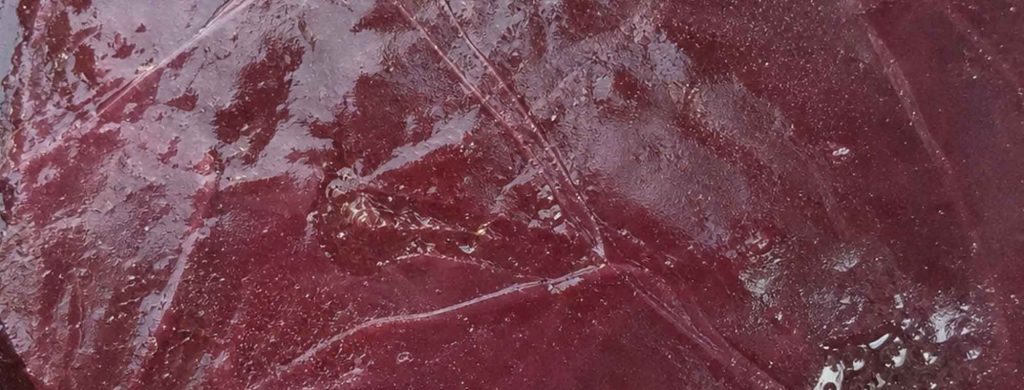
What Does Kahm Usually Look Like?
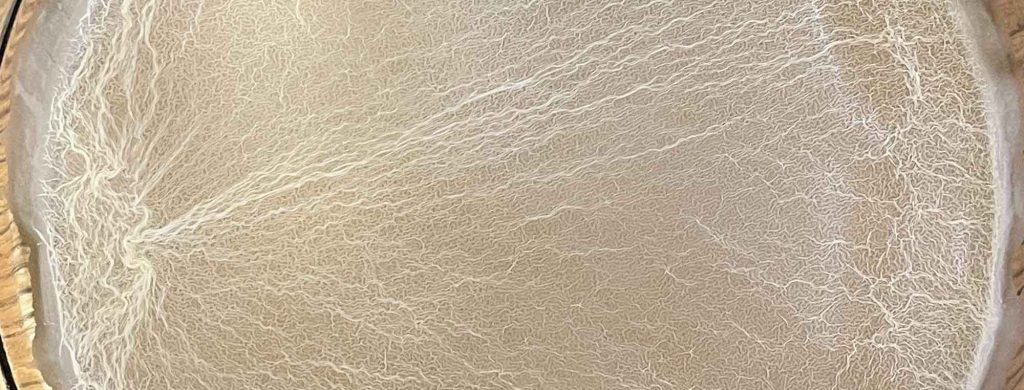
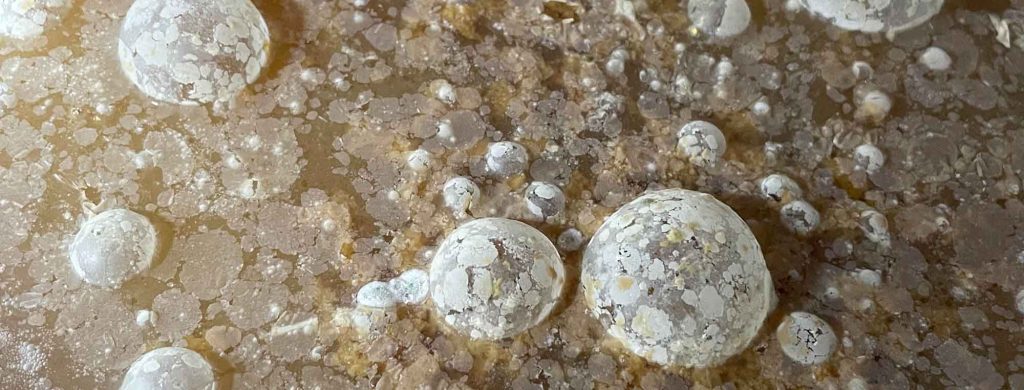
The classic “kahm” appearance is:
- Thin
- Flat
- White to cream colored
- Sometimes slightly yellow or tan
- Smooth, matte, wrinkled, or papery
- Spread across the liquid surface
- Often associated with oxygen exposure
It may look like a skin, a thin layer of paint, or wrinkled.
It may develop small bubbles underneath it or break into patches or rafts. This appearance is consistent with film-forming yeast.
It is not proof of film-forming yeast. That last sentence is the part that gets lost on the internet.
“But It Looks Exactly Like Kahm”
That does not solve the identification problem. A photograph can help you classify a surface growth into broad categories. It cannot normally tell you the species.
A flat white film is much different from fuzzy green mold. That distinction is useful. But a flat white film could represent more than one type of microbial growth. For example, wine research has documented surface films involving Candida, Pichia, Hansenula, Saccharomyces, Brettanomyces, and other yeasts under different conditions. Some are associated with spoilage. Some are part of intentional fermentations.
Even the species associated with wine surface films do not all behave the same way.
So: “It looks like kahm” is reasonable. But “I know exactly what microorganism this is because it looks like kahm” is not.
Kahm Yeast vs. Mold
This is where the term can actually be useful. A typical film-forming yeast growth is flat.
Mold is usually three-dimensional. Look for texture.
More consistent with a yeast film
- Flat or nearly flat
- Thin skin
- Smooth or wrinkled
- White or cream
- Surface-spreading
- No obvious hairs or fuzz
More concerning for mold
- Fuzzy
- Hairy
- Raised
- Clearly three-dimensional
- Green
- Blue
- Black
- Pink
- Orange
- Growing as distinct colonies
Color alone is not a perfect diagnostic test. But fuzzy, raised growth should never be dismissed as “just kahm” because someone online said that kahm can be any color. If you have obvious mold in a beverage, do not treat it as a harmless yeast film.
What About Brettanomyces?
This is another reason the “kahm = harmless wild yeast” explanation is incomplete. Brettanomyces can grow in beer and wine and can participate in surface biofilms or pellicles under some conditions. That does not mean a Brettanomyces pellicle is dangerous.
It means that pellicle formation does not identify the organism.
In fact, Brettanomyces is intentionally used or tolerated in some traditional beer and wine fermentations. In other beverages, it can produce unwanted flavors. The same visual structure can therefore have very different meanings depending on the fermentation.
What About Lactobacillus and Pediococcus?
The same principle applies to bacteria. Certain bacteria can produce surface structures or participate in mixed microbial films. This is especially relevant in sour beer and mixed-culture fermentation.
A brewer who sees a pellicle and immediately says “kahm yeast” may be assigning a yeast diagnosis to something that has not been identified as yeast at all. You cannot determine that from the shape of the film. This is why pellicle is often the more useful word when you do not know what made the film.
What About Acetic Acid Bacteria?
Acetic acid bacteria are another important example. These bacteria need oxygen and can convert ethanol into acetic acid under suitable conditions. That can produce a vinegar-like character. Some acetic acid bacteria can also form surface biofilms.
So if your finished cider or wine develops a surface film and starts smelling strongly like vinegar, do not automatically call it harmless kahm.
The combination of:
oxygen + alcohol + time + surface growth
…can indicate an oxidative spoilage process.
The film is only part of the evidence. The smell, acidity, flavor, alcohol level, fermentation history, and oxygen exposure also matter.
Why “Kahm Is Harmless” Is Too Simple
You will often see: “Kahm yeast is harmless. Just scrape it off.”
That is an oversimplification. The traditional kahm-like film produced by many surface yeasts is not the same thing as mold, and the presence of a film does not automatically mean the beverage is dangerous.
But you cannot establish the identity of the microorganism from appearance alone.
- Some surface yeasts are spoilage organisms.
- Some can produce undesirable acids, aldehydes, or esters.
- Some can consume ethanol.
- Some can alter acidity.
- Some can produce unpleasant flavors.
- And some surface growth may not be yeast at all.
That makes “harmless kahm” a poor universal diagnosis.
Does Kahm Mean the Batch Is Ruined?
Not necessarily. A surface film does not automatically mean you should throw away your batch. But it also does not automatically mean the batch is fine. Look at the entire fermentation.
Ask:
- What are you making?
- What is the current pH?
- What is the alcohol level?
- Is fermentation still active?
- Has the ferment been exposed to oxygen?
- What does the growth actually look like?
- Does it smell normal for the beverage?
- Is there fuzzy or colored growth?
- Has the flavor changed?
- Was this intended to be a mixed or wild fermentation?
The answer to those questions is much more useful than the word “kahm.”
What Should I Do If I See a Thin White Film?
If the film is flat, white, and clearly resembles a surface yeast film, first stop giving it oxygen.
A standard process for dealing with a forming pellicle is to:
- Rack to a sanitized container and minimize headspace.
- Sulfite with campden tablets or metabisulfite powder per the package instructions
- Wait and see if the pellicle returns.
Do not simply scrape off the film and assume the problem is solved. The organisms that produced it would still be in the beverage.

What If It Is a Beer, Cider, Wine, or Mead?
The answer changes with the beverage.
Beer
A thin surface film on a clean, finished beer is not normal for most standard beer fermentations. If you see one, investigate oxygen exposure and possible contamination. Do not automatically call it kahm.
Pichia, Brettanomyces, and other non-Saccharomyces yeasts can grow in beer under suitable conditions. Many are associated with spoilage, especially when oxygen is available.
Cider
Cider can support several types of wild microorganisms. A surface film may develop when oxygen is available, especially during extended aging.
Pay attention to vinegar-like aromas and changes in acidity.
Wine
Wine has a long history of surface-film yeasts. Some wine production even intentionally uses surface-growing yeast. Flor is a famous example. Fino and Manzanilla sherry are intentionally aged under a layer of flor yeast.
That is a good demonstration of why a pellicle is not automatically spoilage. The organism, environment, and process determine what it means.
Mead
Mead can develop surface growth when there is oxygen exposure, especially during long aging. A large headspace is a common problem.
If you see a film on finished mead, minimize oxygen exposure and dose with sulfites after racking from beneath the pellicle.
Kahm vs. Flor
These terms are sometimes mixed together, but they are not interchangeable.
- Flor refers to a specific type of intentional surface yeast growth used in certain traditional wines.
- Kahm is a much broader informal term for unwanted or incidental surface-film growth in fermentation communities.
Both involve microorganisms growing at the liquid surface. They do not mean the same thing.
This is another example of why “there is a film” does not tell you the whole story.
Why Does Everyone Call Everything Kahm?
Because it is a useful word. But that is also the problem.
A beginner sees a strange white layer. They search for “white film fermentation.” They find “kahm yeast.” The next person sees a strange white layer and uses the same term.
Eventually, “kahm” becomes shorthand for:
“That weird harmless-looking stuff floating on my ferment.”
The word then gets applied to yeast films, bacterial films, pellicles, rafts, protein layers, surface debris, and sometimes things that are simply normal fermentation. That is not a microbiological classification, but rather a community shorthand. And shorthand is fine as long as you remember that it is shorthand.
The Better Way to Diagnose Surface Growth
Instead of starting with a name, start with observations.
Step 1: Look at the texture
- Is it flat?
- Fuzzy?
- Slimy?
- Powdery?
- Stringy?
- Three-dimensional?
Step 2: Look at the color
White and cream are common for surface yeasts.
Green, blue, black, and other strong colors are more concerning for mold or other growth.
Step 3: Check the fermentation
Is it actively fermenting? Has gravity stopped changing? How long has it been finished?
Step 4: Check oxygen exposure
Did you leave a large headspace? Was the airlock dry?
Was the fermenter opened repeatedly or did you transfer into a vessel that was much too large?
Step 5: Smell it
A mild yeast or fermentation smell is different from strong vinegar, solvent, rotten, musty, or otherwise abnormal odors.
Smell is useful evidence. It is not a safety test.
Step 6: Check pH when appropriate
A pH measurement gives you real information. It is much more useful than saying, “Reddit says it is kahm.”
A pH reading does not identify the organism either, but it gives you another piece of evidence.
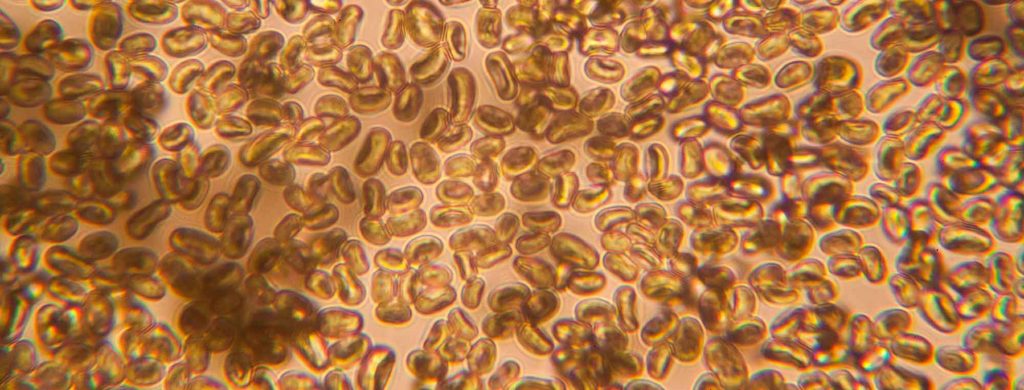
Can You Identify Kahm With a Microscope?
You can see yeast cells with a microscope. That does not necessarily identify the species.
A microscope can help answer:
“Are there yeast-like cells here?”
It generally cannot answer:
“This is definitely species X, therefore it is kahm.”
Species-level identification requires more advanced microbiological methods. For a homebrewer, that level of testing is rarely necessary.
The practical goal is usually to determine whether the growth is:
- Normal fermentation
- A likely surface yeast film
- A likely pellicle
- Mold
- Evidence of oxidative spoilage
- Something that should not be consumed
How Do I Prevent Kahm-Like Films?
The same practices that reduce unwanted oxygen exposure also reduce many surface-film problems.
- Use clean and sanitized equipment.
- Pitch a healthy fermentation culture.
- Avoid unnecessary headspace.
- Keep the fermenter sealed.
- Keep the airlock filled.
- Avoid unnecessary opening.
- Transfer finished beverages with minimal oxygen exposure.
- Keep aging vessels appropriately full.
- Package finished beverages instead of leaving them exposed for weeks.
- Control fermentation temperature.
- Use appropriate sulfite practices for wine and mead when applicable.
The goal is not to create a sterile fermentation, but rather to give your intended fermentation organism a strong advantage.
The Important Difference Between “Wild” and “Bad”
Wild does not automatically mean dangerous. Wild yeast can make excellent beer, cider, wine, and other fermented products. Some traditional beverages depend on mixed microbial populations.
Likewise, a microorganism that is harmless in one fermentation can be undesirable in another.
The important question is not, “Is this wild?”
The important questions are:
- What organism is present?
- What is it doing?
- Is that what you intended?
- Does the finished product remain appropriate for consumption?
Bottom Line
“Kahm yeast” is a useful fermentation term, but it is not a precise diagnosis. It usually describes a flat surface film associated with wild, film-forming yeasts growing where a ferment meets oxygen.
But several different yeasts can produce these films. Other microorganisms can produce pellicles too. A photograph cannot reliably tell you which organism made the film.
So do not treat:
“It looks like kahm”
as equivalent to:
“I know what microorganism this is.”
Instead, look at the texture, color, fermentation stage, oxygen exposure, pH, aroma, and history of the batch. “Kahm” tells you what people think they are seeing. It does not tell you what is actually growing there.