If you are new to homebrewing, you will hear brewers talk about original gravity, or OG.
You may see numbers such as:
- 1.040
- 1.050
- 1.075
- 1.100
These numbers can look confusing at first. Original gravity is simply a measurement of the density of your wort, must, or juice before fermentation begins.
It is one of the most useful measurements in homebrewing.
Your original gravity can help you estimate alcohol content, check your brewing efficiency, compare your batch with the recipe, and understand how much sugar the yeast has available.
The good news is that you do not need complicated equipment. A hydrometer is usually all you need. Be sure to also check out our article on the differences between hydrometers and refractometers.
What Does Original Gravity Mean?
Specific gravity compares the density of a liquid with the density of water.
Water has a specific gravity of approximately 1.000.
Sugar and other dissolved substances make a liquid denser. For example, a beer wort with a specific gravity of 1.050 is denser than water. The number 1.050 is the original gravity if you take the measurement before fermentation.
The more dissolved sugar and other material in the liquid, the higher the gravity will usually be.

Why Is It Called “Original” Gravity?
It is called original gravity because it is the gravity at the start of fermentation.
You measure it before yeast has consumed a significant amount of fermentable sugar. Once fermentation begins, yeast converts sugars into alcohol and carbon dioxide. The specific gravity decreases.
This gives you another useful measurement called final gravity, or FG.
Original Gravity vs. Final Gravity
These two measurements work together.
Original gravity (OG):
The gravity before fermentation.
Final gravity (FG):
The gravity after fermentation is complete.
For example:
- OG: 1.050
- FG: 1.010
The difference between these numbers tells you that fermentation changed the composition of the liquid. You can use OG and FG to estimate the alcohol content.
How Do I Measure Original Gravity?
The easiest method is to use a brewing hydrometer.
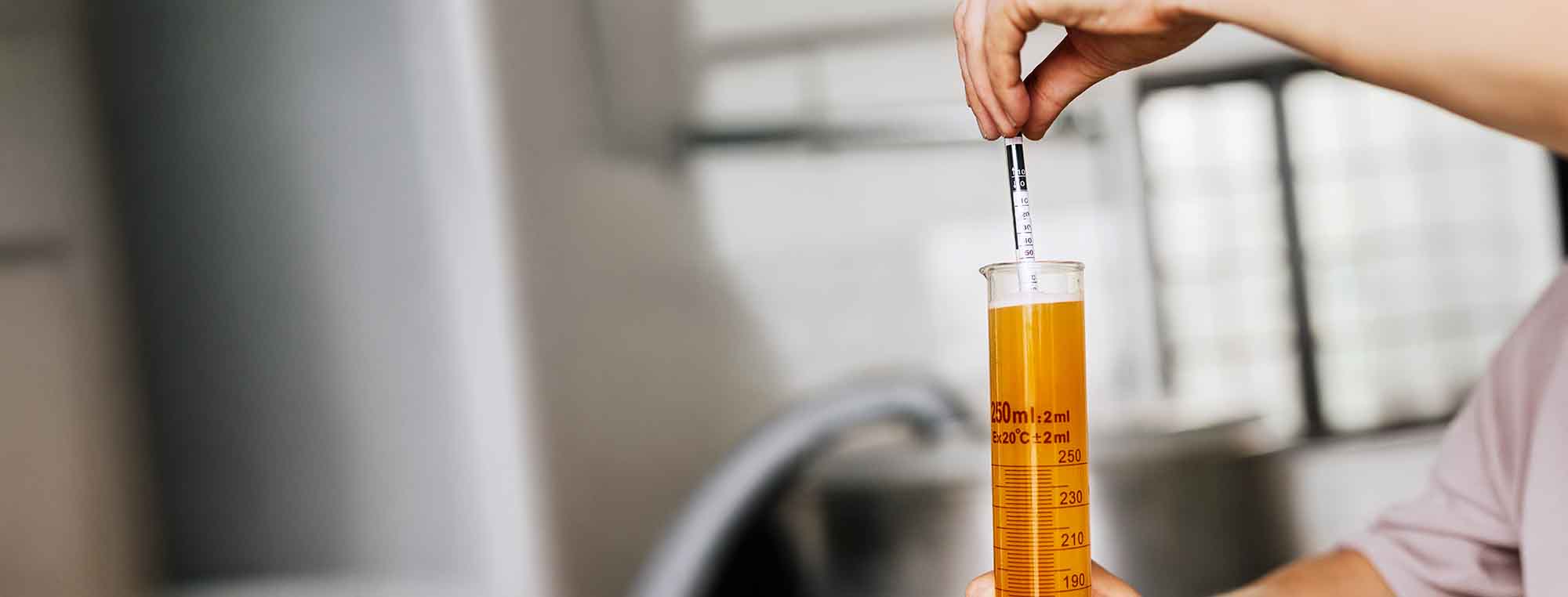
First, prepare your wort, must, or juice. Take a sample before adding yeast. Put the sample into a hydrometer test jar. Place the sanitized hydrometer into the sample.
Let it float freely. Read the scale at the correct point on the liquid surface. Record the result.
That number is your original gravity.

Do I Need a Hydrometer?
You can make homebrew without measuring original gravity.
However, a hydrometer is one of the most useful pieces of equipment for a beginner. It can tell you things that you cannot reliably determine by looking at the fermenter.
For example, an airlock can stop bubbling even when fermentation is still active. A hydrometer can show whether the gravity is actually changing. A basic hydrometer is also useful for beer, mead, wine, and cider.
What Equipment Do I Need?
A basic gravity measurement setup can include:
- A hydrometer.
- A hydrometer test jar.
- A wine thief or other sampling tool.
- A thermometer.
- Sanitizer.
You can also use a refractometer. A refractometer uses only a few drops of liquid.
It is very useful for measuring wort before fermentation. However, alcohol affects refractometer readings after fermentation begins.
For a beginner, a hydrometer is usually easier to understand.
Why Does Original Gravity Matter?
Original gravity gives you useful information about your recipe.
It can help you:
- Estimate potential alcohol.
- Compare your batch with the recipe.
- Calculate brewing efficiency.
- Monitor fermentation.
- Diagnose fermentation problems.
- Calculate approximate alcohol by volume.
It also gives you a record of how your batch started. If your recipe calls for an OG of 1.050 and you measure 1.075, something important has changed.
You can investigate before fermentation progresses too far.
What Is a Typical Original Gravity?
There is no single correct original gravity. Different beverages have different ranges.
Typical beer recipes may have an OG around:
- 1.030 to 1.050 for lighter beers.
- 1.050 to 1.070 for many standard-strength beers.
- 1.070 and higher for strong beers.
Mead, wine, and cider can have very different starting gravities. A high-gravity mead may have an OG well above 1.100. Do not assume that a higher OG means a better beverage.
It simply means that the starting liquid is denser.
Does Higher Original Gravity Mean More Alcohol?
Usually, yes. A higher OG gives yeast more fermentable sugar to convert into alcohol. However, the final alcohol level depends on more than OG. You also need to consider final gravity.
For example, a beer with an OG of 1.070 that finishes at 1.010 will have more alcohol than a beer that starts at 1.070 and finishes at 1.040. Yeast health, yeast strain, fermentation conditions, and recipe composition also matter.

How Do I Calculate Alcohol From OG?
A common homebrewing estimate uses OG and FG.
One simple formula is:
ABV ≈ (OG − FG) × 131.25
For example:
- OG = 1.050
- FG = 1.010
The calculation is:
(1.050 − 1.010) × 131.25 = about 5.3% ABV
This is an estimate. Different formulas can produce slightly different results. The important point is that you need both OG and FG for a useful estimate.
What If My Original Gravity Is Too Low?
Suppose your recipe predicts an OG of 1.050.
You measure 1.040. The batch contains less dissolved material than expected. There are several possible reasons.
For beer, possible causes include:
- Low mash efficiency.
- Incorrect grain amounts.
- Too much water.
- Incomplete extraction.
- Incorrect volume measurement.
- A measurement error.
For extract brewing, a low OG can also result from an incorrect volume calculation. Do not immediately assume that something went wrong with the yeast.
You have not even started fermentation yet.
What If My Original Gravity Is Too High?
A higher-than-expected OG can also have several causes.
Possible causes include:
- Too little water.
- Too much extract.
- Higher mash efficiency.
- Incorrect volume measurement.
- Evaporation during the boil.
- A measurement error.
A very high OG can also create more difficult fermentation conditions. High sugar concentrations can put stress on yeast. This is especially important with high-gravity beer and mead.
Can I Adjust My Original Gravity?
Yes. If your OG is too high, you can usually dilute the wort or must with an appropriate amount of water. If your OG is too low, you may be able to add additional fermentable material.
For beer, this could mean adding malt extract.
For mead, it could mean adding honey.
However, calculate the adjustment before adding anything. Do not add ingredients based on guesswork. You also need to maintain good sanitation.
Should I Measure Before or After Adding Yeast?
Measure original gravity before fermentation begins.
Ideally, take the reading after all of your fermentable ingredients and brewing water are mixed. Then take the measurement before pitching yeast. This gives you a clean starting point.
If you forget to take the measurement, you may still be able to estimate OG from the recipe. However, an actual measurement is better.
Can I Measure Original Gravity After Pitching Yeast?
You can measure the gravity shortly after pitching yeast.
However, fermentation may already have started. The reading may no longer represent the true original gravity.
If you need an exact OG, measure before pitching yeast.
Does Temperature Affect Original Gravity?
Yes. Hydrometers are calibrated for a specific temperature.
The calibration temperature is normally printed on the hydrometer. A sample that is warmer or colder can produce a different reading.
Some hydrometers are calibrated at 60°F (15.6°C). Others may use a different temperature.
Check your hydrometer. Use a temperature correction table or brewing calculator when necessary.
Can I Put a Hydrometer in Hot Wort?
Do not do this unless the hydrometer is specifically designed for the temperature. Hot wort can damage some hydrometers.
It can also produce an inaccurate reading. Take a sample and cool it to a suitable temperature before measuring.
A refractometer can be more convenient for hot-side measurements, but you should still follow the manufacturer’s temperature limits.
What Is Plato?
Brewers sometimes express wort strength in degrees Plato instead of specific gravity. Plato represents the approximate percentage of dissolved extract by weight.
For example, a wort around 12° Plato is roughly equivalent to a specific gravity around 1.048. You may see Plato used in professional brewing.
Most homebrew recipes in the United States use specific gravity. You do not need to understand Plato to use a hydrometer.
What Is Brix?
Brix is another way to describe dissolved sugar concentration. It is commonly used with refractometers.
You may see Brix used for:
- Fruit juice.
- Wine grapes.
- Mead must.
- Wort.
Before fermentation, Brix can be converted to an approximate specific gravity.
Once alcohol is present, the conversion becomes more complicated.

Can I Use a Refractometer Instead?
Yes. A refractometer is excellent for measuring original gravity. You only need a few drops of wort. This can be useful when you want to avoid taking a large sample.
For example, a refractometer can quickly tell you the gravity of wort before you transfer it to the fermenter. Once fermentation begins, alcohol affects the reading. You then need a correction calculation.
This is why many beginners use a hydrometer for fermentation measurements.
What If My OG Does Not Match the Recipe?
Do not panic.
A difference of a few gravity points does not automatically mean that the batch is ruined. For example, an expected OG of 1.050 and an actual OG of 1.047 is usually not a major problem. The finished beer may simply have slightly less alcohol than expected.
Larger differences are worth investigating. Record the actual OG, then adjust your expectations for the batch.
Does Original Gravity Tell Me How Sweet the Beer Will Be?
Not by itself.
A high OG does not automatically mean a sweet beer. Yeast can ferment some of the sugars. The final gravity is much more useful for understanding how much material remains after fermentation.
Recipe ingredients also affect sweetness, body, and flavor. Two beers with the same OG can finish at different gravities. They can therefore taste very different.
What About Unfermentable Sugars?
Not every sugar in wort is fermentable.
Some carbohydrates remain after yeast finishes fermentation.
This is one reason that final gravity does not normally reach 1.000 in beer.
The amount of fermentable and unfermentable material depends on the recipe and brewing process.
Mash temperature, yeast strain, malt selection, and other factors can all affect fermentability.
Does Original Gravity Matter for Mead?
Yes.
OG is especially useful for mead. Honey contains a large amount of sugar. Mead recipes can have a wide range of starting gravities.
A hydrometer can tell you exactly where your batch started, which helps you track fermentation and estimate the final alcohol content.
It can also help identify a high-gravity fermentation that is difficult for the yeast.
Does Original Gravity Matter for Wine?
Yes.
Wine makers can use gravity to estimate the sugar available for fermentation. It can also help estimate potential alcohol.
Grape juice and other fruit juices can also be measured with a refractometer before fermentation.
Does Original Gravity Matter for Cider?
Yes. Apple juice contains fermentable sugar. Measuring the OG tells you how much sugar was present before fermentation.
You can then compare the OG with the final gravity after fermentation and this can help you estimate alcohol content.
What Is Potential Alcohol?
Some hydrometers have a potential alcohol scale.
This scale estimates how much alcohol could be produced if the available fermentable sugar were completely fermented.
Do not treat the number as an exact prediction. The actual alcohol content depends on fermentation and final gravity. A standard gravity reading is usually more useful.

Should I Record My Original Gravity?
Absolutely. Write it down.
You can keep a brewing notebook or use a brewing app. Some brewers will write it on painter’s tape and stick it directly on the fermenter.
Record:
- Date.
- Recipe.
- Batch size.
- Original gravity.
- Yeast strain.
- Fermentation temperature.
- Nutrient additions, if applicable.
- Final gravity.
These records become more valuable as you brew more batches.
You can compare your actual results with your previous batches.
What If I Forget to Take an OG Reading?
Your batch is not ruined.
You can estimate the OG from your recipe by using a calculator like MeadTools. If you know the exact amount of fermentable ingredients and final volume, brewing software can often provide a reasonable estimate.
However, you will not have an actual measurement.
You also lose some information for calculating your final alcohol content. This is one reason to make the OG measurement part of your normal brew-day routine.
The Bottom Line
Original gravity is the specific gravity of your wort, must, or juice before fermentation begins.
It tells you how dense the starting liquid is. It is useful because it gives you a starting point for measuring fermentation.
A hydrometer is the simplest tool for measuring OG. A refractometer can also measure OG and uses only a few drops.
Record your original gravity before pitching yeast. Then measure gravity again during fermentation. When you combine OG with final gravity, you can estimate alcohol content and learn much more about what happened during fermentation.
The important thing to remember is simple:
OG tells you where your fermentation started. FG tells you where it finished.
Together, they give you one of the most useful measurements in homebrewing.