ABV means alcohol by volume. It tells you how much of the finished drink is alcohol.
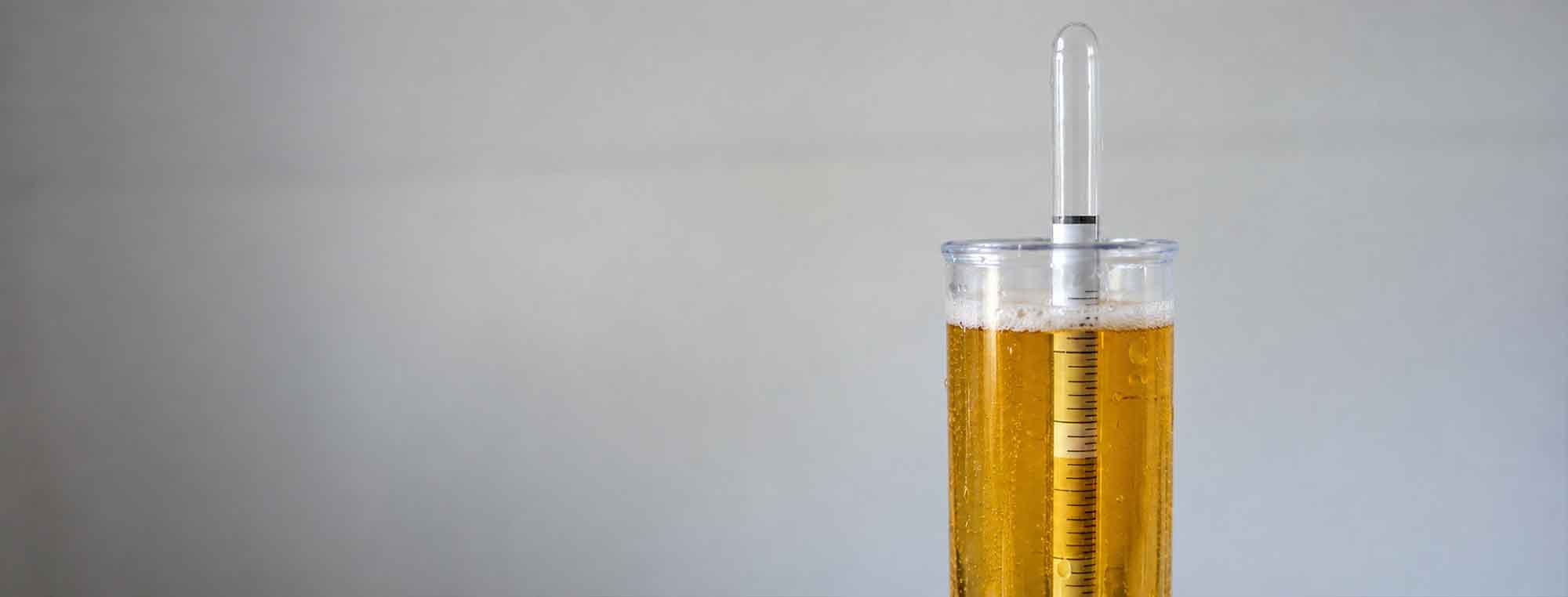
You do not need expensive equipment to calculate ABV at home. You only need a hydrometer, an original gravity reading, and a final gravity reading.
The basic calculation is:
ABV = (Original Gravity − Final Gravity) × 131.25
ABV Calculator
For example:
- Original gravity: 1.080
- Final gravity: 1.010
- Difference: 0.070
- 0.070 × 131.25 = 9.19% ABV
Your finished drink is about 9.2% ABV.
This calculation works for beer, mead, cider, and most fruit wines.
What Is Original Gravity?
Original gravity (OG) is the specific gravity of your liquid before fermentation starts. It tells you how much dissolved material is in the liquid at the start.
Some of that material is fermentable sugar. Yeast converts fermentable sugar into alcohol and carbon dioxide.
For example:
- Water has a specific gravity close to 1.000.
- A beer wort may have an OG of 1.050.
- A cider may have an OG of 1.050.
- A mead may have an OG of 1.100 or higher.
- A dessert wine may have an OG above 1.100.
Record your OG before you pitch yeast.
If you forget to take the reading, you can sometimes estimate OG from a recipe or ingredient data. That is less accurate than measuring it yourself.
What Is Final Gravity?
Final gravity (FG) is the specific gravity of your beverage after fermentation. As yeast consumes sugar, the gravity usually drops.
For example:
1.080 → 1.040 → 1.020 → 1.010
The final reading is 1.010.
You should not assume that fermentation is finished because the gravity is low. Take another reading after a few days. If the gravity stays the same, you have evidence that fermentation has stopped.
The Basic ABV Formula
Use this formula for most homebrew:
ABV = (OG − FG) × 131.25
The important part is that OG and FG are gravity readings, not percentages.
Example: Beer
Your beer starts at: OG = 1.050
It finishes at: FG = 1.010
Calculate the difference: 1.050 − 1.010 = 0.040
Then: 0.040 × 131.25 = 5.25
Your beer is about: 5.3% ABV
Example: Cider
Your cider starts at: OG = 1.060
It finishes at: FG = 1.000
Calculate: 1.060 − 1.000 = 0.060
Then: 0.060 × 131.25 = 7.875
Your cider is about: 7.9% ABV
Example: Mead
Your mead starts at: OG = 1.110
It finishes at: FG = 1.015
Calculate: 1.110 − 1.015 = 0.095
Then: 0.095 × 131.25 = 12.47
Your mead is about: 12.5% ABV
Example: Fruit Wine
Your wine starts at: OG = 1.090
It finishes at: FG = 0.995
Calculate: 1.090 − 0.995 = 0.095
Then: 0.095 × 131.25 = 12.47
Your wine is about: 12.5% ABV
Why Does the Gravity Drop?
The gravity drops because fermentation changes the composition of the liquid.
Yeast consumes fermentable sugars and produces:
- Alcohol
- Carbon dioxide
- Other fermentation products
Alcohol is less dense than water. As sugar disappears and alcohol increases, the specific gravity usually decreases. This is why the difference between OG and FG gives you an estimate of the alcohol produced during fermentation.

You Need Both Readings
You cannot calculate an accurate ABV from the final gravity alone. You need to know where the fermentation started.
For example, an FG of 1.000 could represent very different beverages. A batch that started at 1.040 and finished at 1.000 fermented about:
(1.040 − 1.000) × 131.25 = 5.25% ABV
A batch that started at 1.100 and finished at 1.000 fermented about:
(1.100 − 1.000) × 131.25 = 13.13% ABV
Both finished at 1.000. They do not have the same ABV.
What If My Final Gravity Is Below 1.000?
That is normal for some fermented beverages. Alcohol is less dense than water, so a dry beer, wine, cider, or mead can finish below 1.000.
For example:
OG = 1.080
FG = 0.995
The calculation is:
(1.080 − 0.995) × 131.25 = 11.16% ABV
The important thing is to use the actual hydrometer reading. Do not force the FG to 1.000 just because you expect a dry beverage to finish there.
What If My Final Gravity Is Above 1.000?
That is also normal. A beverage can finish above 1.000 and still be fully fermented.
Some reasons include:
- Residual sugars
- Unfermentable sugars
- Malt-derived dextrins
- Lactose
- Certain fruit components
- High-gravity fermentation
- Yeast strain characteristics
A mead that finishes at 1.015 is not automatically stuck. A cider that finishes at 1.005 is not automatically unfinished. A beer at 1.012 can be completely normal. The important question is whether the gravity is stable.
Related: Complete Guide to Stuck or Stalled Fermentations
Do Not Use the Airlock to Calculate ABV
An airlock is not an alcohol meter.
Bubbles can happen because of:
- Active fermentation
- Temperature changes
- Changes in atmospheric pressure
- Degassing
- Movement of the fermenter
- Dissolved carbon dioxide escaping
A quiet airlock does not prove that fermentation is finished. Take a hydrometer reading instead.
Do Not Use Fermentation Time to Calculate ABV
You cannot reliably calculate ABV from fermentation time.
For example, saying:
“It fermented for two weeks, so it must be about 10%.”
…does not work.
Two batches can ferment for the same amount of time and produce different amounts of alcohol. Yeast strain, temperature, starting gravity, nutrients, oxygen, pH, and other factors affect fermentation. Again, use gravity measurements.
What If I Did Not Take an Original Gravity Reading?
You still have options, but none are as good as having the actual OG.
Option 1: Use the recipe
If you made a brew from a known recipe, you may be able to calculate the expected OG from the ingredient amounts and your batch size.
This gives you an estimate.
Option 2: Use an OG calculator
Recipe software can estimate OG from ingredients. This can work well for beer when you know your ingredients and efficiency.
It is less reliable when the exact sugar content of fruit or juice is unknown.
Option 3: Use the label on your juice
For cider and wine made from commercial juice, the nutrition label can sometimes help estimate the starting sugar content.
This is still an estimate.
Option 4: Accept that the ABV is unknown
Sometimes this is the most accurate answer. A made-up OG does not make an accurate ABV.
If you did not measure the starting gravity, you can report an estimated ABV, but label it as an estimate.
How to Measure Gravity Correctly
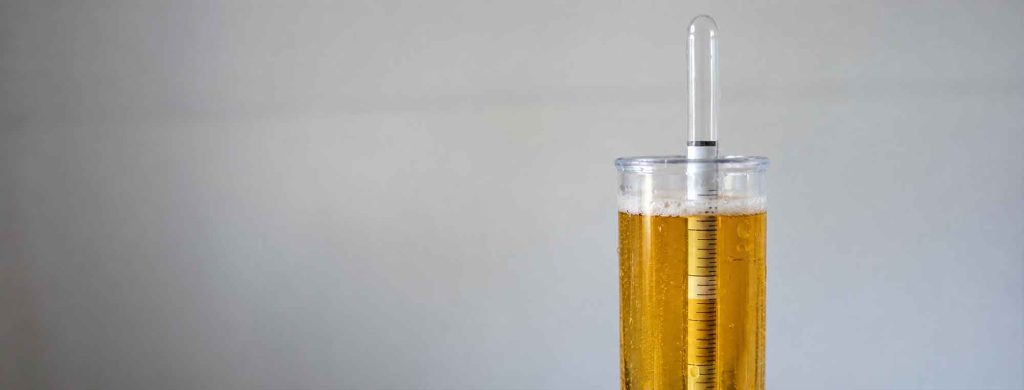
A hydrometer only helps if you use it correctly.
- Take a sample from the fermenter.
- Avoid collecting a sample full of bubbles or foam.
- Fill a hydrometer test jar high enough for the hydrometer to float freely.
- Place the hydrometer in the sample.
- Give it a gentle spin.
- Make sure it does not touch the side of the container.
- Read the gravity at the surface of the liquid.
Check the temperature. Most hydrometers are calibrated to a specific temperature, often 60°F or 68°F. Temperature affects the reading.
For normal homebrew measurements, a small temperature difference may not change your ABV calculation very much. For the most accurate work, use a temperature correction calculator designed for your hydrometer.
ABV and Apparent Attenuation
Beer brewers may also use apparent attenuation.
The basic formula is: Apparent attenuation = (OG − FG) ÷ (OG − 1.000) × 100
For example:
OG = 1.050
FG = 1.010
(1.050 − 1.010) ÷ (1.050 − 1.000) × 100
0.040 ÷ 0.050 × 100 = 80%
The beer has an apparent attenuation of 80%. Attenuation and ABV are related, but they are not the same measurement. ABV tells you the estimated alcohol content. Attenuation tells you how much of the original extract was removed from the gravity during fermentation.
ABV in Mead Is Sometimes More Complicated
Mead can create unusually large gravity changes.
A traditional mead may start around 1.080. A stronger mead may start around 1.120 or higher.
High starting gravity puts more stress on yeast. The yeast may ferment slowly, stop early, or leave residual sugar. This makes accurate gravity measurements especially important.
For a high-gravity mead, do not assume that a high FG means the mead is finished. Take repeated readings. If the gravity is falling, fermentation is still progressing. If the gravity is stable, you have stronger evidence that fermentation has stopped.
ABV in Cider
Cider is often easy to calculate because apple juice contains fermentable sugar and dry cider can finish close to 1.000 or below.
For example:
OG = 1.055
FG = 0.998
(1.055 − 0.998) × 131.25 = 7.48% ABV
That cider is about 7.5% ABV.
Do not assume that all apple juice starts at the same gravity. Measure the juice. Different apples, juice blends, concentrates, and added sugar can produce different starting gravities.
ABV in Wine
Wine can have a large gravity drop because fruit juice can contain a lot of fermentable sugar.
For example:
OG = 1.085
FG = 0.995
(1.085 − 0.995) × 131.25 = 11.81% ABV
That wine is about 11.8% ABV.
Fruit can make gravity measurements more difficult. Pulp, seeds, suspended solids, and bubbles can affect hydrometer readings. Take a clean sample and allow excessive foam to settle before reading.
ABV in Beer
Beer can have additional complications because malt contains both fermentable and less-fermentable carbohydrates. Two beers with the same OG can finish at different gravities.
For example:
Beer A:
1.050 → 1.008
Beer B:
1.050 → 1.014
Their estimated ABVs are:
Beer A:
(1.050 − 1.008) × 131.25 = 5.51%
Beer B:
(1.050 − 1.014) × 131.25 = 4.73%
The starting gravity was identical. The final gravity was different. Therefore, the estimated ABV is different.
What Happens If I Add Sugar After Fermentation?
This is where simple ABV calculations can become misleading.
Suppose you ferment a mead to 12% ABV. Then you add more fermentable honey. If the yeast ferments that honey, the alcohol content increases. Your original OG-to-FG calculation does not include that later fermentation.
The same problem can happen when you add:
- Fruit
- Juice
- Honey
- Table sugar
- Concentrate
- Syrup
after the original OG measurement.
If you make substantial additions during fermentation, the simple calculation may no longer describe the complete fermentation.
What Happens If I Add Alcohol?
Adding vodka, brandy, rum, or another alcoholic ingredient is a different situation.
The standard OG/FG formula estimates alcohol produced by fermentation. It does not calculate the final ABV of a beverage that has been fortified by adding an existing alcoholic liquid. For fortified drinks, calculate the alcohol contribution from each component and account for the final volume.
If you add another alcoholic beverage, use this formula:
New ABV = (ABV₁ × Volume₁ + ABV₂ × Volume₂) ÷ Total Volume
That looks complicated, but the process is simple:
- Multiply the ABV of each liquid by its volume.
- Add those numbers together.
- Divide by the total volume.
For example, you have 1 gallon of mead at 12% ABV and add ½ gallon of brandy at 40% ABV.
12 × 1 = 12
40 × 0.5 = 20
12 + 20 = 32
You now have 1.5 gallons of liquid.
32 ÷ 1.5 = 21.3% ABV
Your finished beverage is approximately 21.3% ABV. This same method works when mixing two homebrewed alcoholic beverages with different ABVs.
What Happens If I Dilute My Mead, Beer, Wine, or Cider?
Adding water or juice to a finished brew lowers the ABV because the same amount of alcohol is now spread through more liquid.
For example, suppose you have:
1 gallon at 12% ABV
You add:
1 gallon of water
You now have:
2 gallons at 6% ABV
The alcohol did not disappear. You simply doubled the amount of liquid.
For a simple calculation:
New ABV = (Old ABV × Old Volume) ÷ New Volume
For example:
(12 × 1) ÷ 2 = 6% ABV
You can use the same idea for smaller additions.
Suppose you have 1 gallon at 12% ABV and add ½ gallon of water.
You now have 1.5 gallons.
(12 × 1) ÷ 1.5 = 8% ABV
So your finished beverage is about 8% ABV.
The important thing to remember is: More water or juice = lower ABV.
This calculation assumes that the added liquid contains no alcohol. If you add another alcoholic beverage, you need to include the alcohol in both liquids.
Why ABV Calculators May Give Slightly Different Answers
You may find calculators that use slightly different constants.
The common homebrew formula uses 131.25. Some calculators use constants around 131 or other values. You may therefore see small differences between calculators.
Do not worry about a result such as:
5.2% vs. 5.3% ABV
Your hydrometer readings have their own measurement uncertainty. Homebrew ABV should usually be treated as an estimate, not a laboratory measurement.
What About a Refractometer?
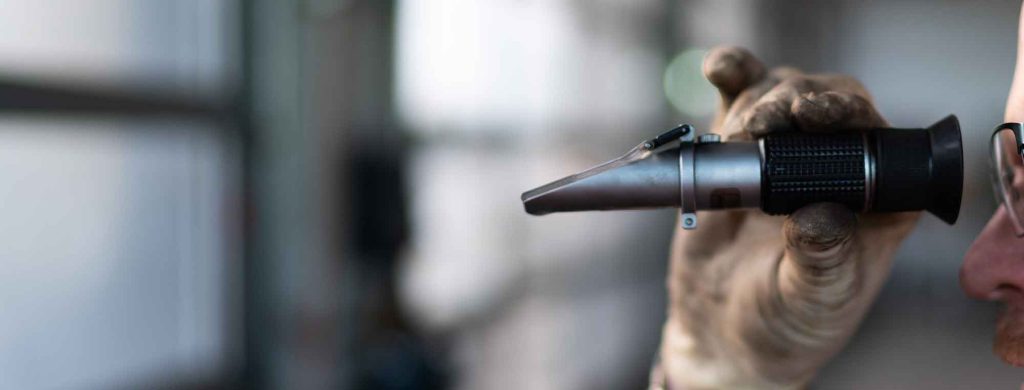
A refractometer is excellent for measuring wort or juice before fermentation. After fermentation starts, alcohol changes the way light passes through the sample. A normal refractometer reading cannot be treated as a direct specific gravity reading after fermentation.
You need a fermentation correction calculator that uses the original Brix reading and the current Brix reading.
For simple homebrew ABV calculations, a hydrometer is usually easier.
Related: Hydrometer vs. Refractometer – Which is Better?
Can I Calculate ABV Without a Hydrometer?
You can estimate it.
You cannot measure it accurately from:
- Fermentation time
- Airlock activity
- Taste
- Color
- Yeast amount
- Recipe name
- Bubble rate
- How strong the drink tastes
If you want to calculate ABV with confidence, take gravity readings. A hydrometer is one of the most useful measurement tools in homebrewing.
ABV Calculation Cheat Sheet
| Beverage | OG | FG | Estimated ABV |
| Light beer | 1.045 | 1.008 | 4.9% |
| IPA | 1.065 | 1.010 | 7.2% |
| Cider | 1.055 | 0.998 | 7.5% |
| Mead | 1.090 | 1.010 | 10.5% |
| Strong mead | 1.120 | 1.015 | 13.8% |
| Fruit wine | 1.085 | 0.995 | 11.8% |
These are examples. Your actual ABV depends on your actual gravity readings.
A Simple ABV Workflow
Use this process for almost any homebrew.
1. Measure the original gravity
Take a hydrometer reading before fermentation.
Record it.
2. Ferment normally
Give the yeast enough time and the conditions it needs.
3. Measure the gravity
Take a hydrometer reading after fermentation appears to be complete.
4. Wait
Take another reading after 2–3 days.
5. Compare the readings
If the gravity is unchanged, you have evidence that fermentation has finished.
6. Calculate ABV
Use:
(OG − FG) × 131.25
7. Record the result
Write the estimated ABV in your batch notes.
If you make later additions that contain fermentable sugar, record those too.

Common ABV Calculation Mistakes
Mistake 1: Using 1.000 as the FG automatically
Use your actual final gravity.
Mistake 2: Using the first hydrometer reading as the FG
The final gravity must come after fermentation.
Mistake 3: Reading the airlock
An airlock does not measure ABV.
Mistake 4: Assuming a 1.000 FG means zero alcohol
The alcohol comes from the gravity drop from OG to FG.
Mistake 5: Forgetting added sugar
Later fermentable additions can increase the actual ABV.
Mistake 6: Treating an estimated OG as a measured OG
Label calculated or recipe-based OG values as estimates.
Mistake 7: Measuring an unstable FG
If the gravity is still dropping, you do not have a final gravity yet.
Mistake 8: Returning the hydrometer sample
Do not return a sample to the fermenter.
What If I Want to Know the Exact ABV?
A homebrew hydrometer calculation is an estimate. It is usually more than good enough for deciding how strong your beer, wine, cider, or mead is.
If you need a laboratory-grade alcohol measurement, use laboratory analysis. For normal homebrewing, accurate OG and FG readings are the practical solution.
Bottom Line
To calculate the ABV of your mead, beer, wine, or cider:
ABV = (OG − FG) × 131.25
Measure the original gravity. Measure the final gravity. And make sure the final gravity is stable.
Subtract FG from OG.
Multiply by 131.25.
That gives you an estimated ABV. The most important part is not the math, but rather to get good gravity readings.
Measure it. Record it. Measure it again. Then do the math.